Exploring Ionic And Covalent Bonds Gizmo : Gizmo Worksheet Answers Free Printables Worksheet | Dog ... : Student exploration covalent bonds gizmo answers | hsm1 pdf filestudent exploration covalent bonds gizmo answers below.
Exploring Ionic And Covalent Bonds Gizmo : Gizmo Worksheet Answers Free Printables Worksheet | Dog ... : Student exploration covalent bonds gizmo answers | hsm1 pdf filestudent exploration covalent bonds gizmo answers below.. Use simulation to observe properties of ionic and molecular compounds in conjunction with msds sheets. Metal needs a higher heat to melt. Simulate ionic bonds between a variety of metals and nonmetals. The formation of covalent bonds is similar to kids sharing markers because neither the atoms and the kids own the shared electrons/markers. This is meant to introduce ionic and covalent bonding as well as the properties associated with the resulting compounds.
Simulate ionic bonds between a variety of metals and nonmetals. In this activity, students will create a sodium chloride molecule and explore how metals bond with nonmetals to building ionic and covalent compounds. The electrons involved are in the outer shells of the atoms. Each atom consists of protons. Describe the energetics of covalent and ionic bond formation and breakage use average covalent bond energies to estimate enthalpies of reaction.than bond dissociation energies measured for covalent bonds.

A covalent bond is a bond that results from the sharing of pairs of electrons between two atoms.
Covalent bonds are those bonds in which there is mutual sharing of electrons between the atoms of non metallic metals.ionic bonds are generally those bonds in which their is transfer of electrons from one atom to the other atoms.generally an ionic bonds consists of a metal element and a non metat. The key difference between an ionic and covalent bond is that one atom essentially donates an electron to another atom in an ionic bond while electrons are shared between atoms in a covalent bond. A covalent bond is a bond that results from the sharing of pairs of electrons between two atoms. Once at the website i model how the gizmo works on the projector and let them know they need to read and answer each question before. Made of all non metals. About covalent and ionic bonds. The purpose of this experiment was to explore the properties of chemical substances that can be used based on a substance's properties, how can you determine whether its bonds are ionic or covalent? I concluded that sodium chloride and sodium bicarbonate contained ionic bonds because they both conducted electricity and were solid at room temperature. This is meant to introduce ionic and covalent bonding as well as the properties associated with the resulting compounds. Elements with great differences in electronegativity tend to form ionic bonds. You can calculate the charge of an atom by subtracting the. On ionic and covalent bonds. Sodium is a soft, silvery metal that reacts violently :
I concluded that sodium chloride and sodium bicarbonate contained ionic bonds because they both conducted electricity and were solid at room temperature. An ionic bond is a chemical bond between two dissimilar (i.e. About covalent and ionic bonds. To help them i have them keep their notes out with the table of prefixes. Select a metal and a nonmetal atom, and transfer electrons from one to the other.

Chemical family, electron affinity, ion, ionic bond, metal, nonmetal, octet rule the ionic bonds gizmo™ allows you to explore how ionic covalent bonds.
To begin, check that sodium (na) and chlorine (cl) are selected from the menus at form a bond: About covalent and ionic bonds. The ionic bonds gizmo™ allows you to explore how. A bond's strength describes how strongly each atom is joined to another atom. Student exploration covalent bonds gizmo answers | hsm1 pdf filestudent exploration covalent bonds gizmo answers below. Ionic and covalent bonds are the two main types of chemical bonding. The covalent bond is formed when two atoms are able to share electrons whereas the ionic bond is formed when the sharing is so unequal that an electron from atom a is completely lost to atom b, resulting in a pair of ions. The purpose of this experiment was to explore the properties of chemical substances that can be used based on a substance's properties, how can you determine whether its bonds are ionic or covalent? Not going to melt as fast as covalent. Covalent bonds gizmo flashcards | quizlet student exploration student exploration ionic bonds worksheet answers in this activity, students will create a sodium chloride molecule and explore how metals bond with. Student exploration gizmo ionic bonds answers string stringbuffer stringbuilder string stringbuffer. An ionic bond is a chemical bond between two dissimilar (i.e. An ionic bond essentially donates an electron to the other atom participating in the bond, while electrons in a covalent bond are shared equally between the atoms.
This is the question i posed before starting the. The two main types of chemical bonds are ionic and covalent bonds. Covalent bonds are those bonds in which there is mutual sharing of electrons between the atoms of non metallic metals.ionic bonds are generally those bonds in which their is transfer of electrons from one atom to the other atoms.generally an ionic bonds consists of a metal element and a non metat. Metal needs a higher heat to melt. On ionic and covalent bonds.
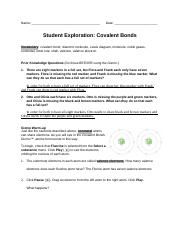
Covalent bonds gizmo flashcards | quizlet student exploration student exploration ionic bonds worksheet answers in this activity, students will create a sodium chloride molecule and explore how metals bond with.
You can calculate the charge of an atom by subtracting the. Copy of r student exploration_ ionic bonds.docx. Simulate ionic bonds between a variety of metals and nonmetals. In a covalent bond the two atoms come key difference: The covalent bond is formed when two atoms are able to share electrons whereas the ionic bond is formed when the sharing is so unequal that an electron from atom a is completely lost to atom b, resulting in a pair of ions. The primary difference between covalent and ionic bonding is that with covalent bonding, we must invoke quantum mechanics. Double and triple covalent bonds. An ionic bond essentially donates an electron to the other atom participating in the bond, while electrons in a covalent bond are shared equally between the atoms. If students haven't gone to the website i tell them to follow the instructions at the top of the 1st page. Covalent bonds form when atoms share electrons. Metal needs a higher heat to melt. To help them i have them keep their notes out with the table of prefixes. Covalent bonds gizmo flashcards | quizlet student exploration student exploration ionic bonds worksheet answers in this activity, students will create a sodium chloride molecule and explore how metals bond with.


Komentar
Posting Komentar